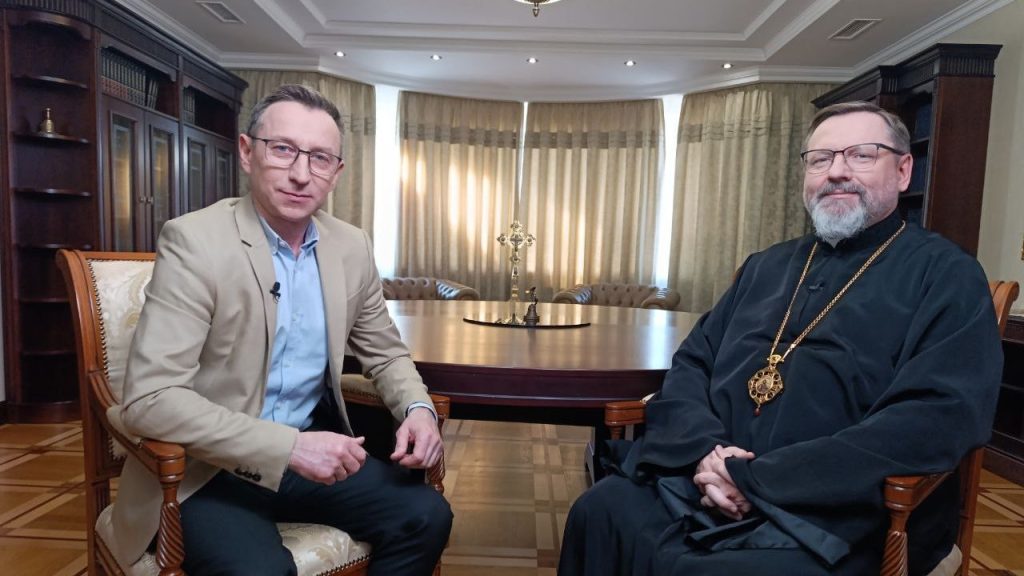
Text of an interview with His Beatitude Sviatoslav (Shevchuk), Head of the Ukrainian Greek Catholic Church
Presenter (Vitaliy Stebenev):
Recently, at a meeting with students and teachers of Bohdan Khmelnytsky Cherkasy National University, you said the following words: that the source of resilience of the Ukrainian soldier is faith in God. What is the basis for these words of yours?
His Beatitude Sviatoslav:
Our common road — the road of the believers of Ukraine — today is truly a key, a source of hope. Hopes that the Lord God travels with us. And our path is, first of all, to Him and, obviously, to victory.
I voiced the phrase you mentioned in the context of a lecture where I presented the results of a survey of military chaplains.
Today it is no secret that the Ukrainian warrior surprises the whole world with his resilience. One of the chaplains of NATO troops said that after the phenomenon of the resilience of the Ukrainian people during this war, the Alliance is rethinking its doctrine. Because the motivation of the serviceman to perform a combat mission was not fully taken into account. And our military chaplains really made a study, which they presented to the Commander-in-Chief of the Ground Forces. That is, where does the ability of our soldier to survive in that struggle come from. And a scientific study, according to scientific methodology, showed that of all the answers, what is the source of your resilience, where you get that strength, our warrior put his faith in God in the first place.
But let’s listen to what it means to believe in God in war today? What does it mean to believe in God during a full-scale invasion? Obviously, we are not talking about some abstract ideas, because faith in ideas does not add strength. It is obvious that the warrior spoke about his resilience in the context of a certain relationship, communication, in particular communication with God.
A source of resilience means that you and I are drawing strength from somewhere. And our soldiers testify to us that this is their testimony of faith, that in combat circumstances they add strength to the skill, the ability of our soldiers to build their relationship with the living God. Anyone who feels that his life has an eternal value is able to give his life for something that is more important than some kind of temporary benefit, comfort, selfish needs for self-preservation, and so on. That is, this complete altruism is the fruit of the fact that the Ukrainian soldier believes in the resurrection. He believes that the calling, in particular that of a Christian, is a vocation to eternity, that even suffering and death never have the last word in human life. And we see that that soldier, that warrior who prays, who reads the Holy Scriptures, who knows, thanks to his faith in God, remains a man in inhuman circumstances, that warrior is able to win. That warrior is able to survive.
Therefore, faith in God is the source of resilience of the Ukrainian soldier.
Presenter:
70% of Ukrainians consider themselves Christians. What does the Bible say about how a Christian should live?
His Beatitude Sviatoslav:
Christ says, “Not everyone who says to Me, ‘Lord, Lord,’ will enter the kingdom of heaven. Obviously, the percentages that statistics give us, on the one hand, can please us, because it means that Ukrainians are a Christian people. But when we look at what influences our specific life decisions, how we build our own daily lives, how we choose. It’s not just about politics, it’s about my personal choices, which I have to make every day. Well, we see that not always those who call themselves Christians give a good witness to a truly Christian life.
We Christians believe in the sacrament of the Incarnation, that God became man and the Word became flesh and dwelt among us, John the Evangelist tells us in the prologue to his Gospel. If we really believe this, it means that we should put our faith into our personal lives. Therefore, our actions that we do can also be one of the forms, types of confession of my Christian faith. If I go to church or prayer meetings in a house of worship on Sundays, but when I leave the church and live like a Gentile, it would be better for me to remain silent and not pretend to call myself a Christian. So, I would very much like the 70% of Ukrainians who call themselves Christians to live in a Christian way. Obviously, this is a certain challenge, a certain task. But God’s Word teaches us that it is not enough just to listen. One such example, which we read in the apostolic epistles, says that he who listens to the Word of God and does not obey it is like a person who looks at his face in a mirror. He looks at himself, but as soon as he moves away, he has already forgotten.
Therefore, we need to draw strength from listening to God’s Word precisely in order to live as a Christian in specific life circumstances. And we have a lot of examples in the history of the Church, because it is precisely those persons whom we call martyrs and confessors of faith, heroes of the Christian life, who gave us an example that everything we hear about in the Gospel can be embodied in our lives. The Gospel is good news. God’s Word is not a good idea, it is an invitation to allow God to act in your life. And then this divine-human dimension of Christian life will manifest itself in our present. Therefore, the recipe is simple on the one hand, but on the other hand it can be complicated.
Presenter:
Is it enough for a person to go to church? Is it necessary to read the Bible every day, to know what the Lord says to each person through His Word? What guidelines would you give for Christians?
His Beatitude Sviatoslav:
Following how Ukrainian society experiences its Christian faith today, we see that very often Ukrainians do not know the God in Whom they believe. And this is a big problem, because in order to truly lead a Christian life, we must communicate with God every day. Usually, we call communication with God prayer. But the apostle Paul reminds us that we need to pray without ceasing. That is, if I lived even a minute in today, when I forgot about God, then I did not live those minutes as a Christian. So, prayer is the breath of the soul, the Church Fathers said. And Christian thinkers said: “Tell me how you pray. I’ll tell you what kind of Christian you are.”
We hear people sometimes say, “But I have God in my heart.” And then I ask: “Do you communicate with Him? Do you listen to Him? And what did He say to you today?” And this type of question sometimes puts this person in a very awkward position. It seems that we carry God in our hearts, but we do not pay any attention to Him and live as if God did not exist.
So, communicating with God in prayer is the first, I would say, necessity in order to be able to be a Christian. And so prayer has different forms, different ways. For example, our traditional Ukrainian piety tells us that we should not start anything without prayer. Then even our daily work, if we start it with prayer, it turns into prayer. Our service to our neighbor is one of the types of our communication with God. For Christ said, “What you did to one of the least of mine, you did to me.” Therefore, even social service in a Christian context is not ordinary human philanthropy. No, this is a religious act of respect, reverence for Christ, Who is present in the figure of the last, weakest, most needy.
Obviously, one cannot be a Christian without reading the Holy Scriptures. In Catholic history, we have such an ascetic and translator of the Bible into Latin, St. Jerome from the fourth century. He said verbatim, “He who does not know the Scriptures does not know Jesus Christ.” Therefore, we encourage you to read the Scriptures every day, to enter into personal communion with God every day, starting from God’s Word.
This is such a very interesting moment when I pick up the Bible, open it and the moment of reading turns into a moment of communication with God. Then the written text becomes the living Word of God. Then what I read, I experience as an appeal of the living God to me now, today. And that Word of God is spoken by the Lord, and I am called to hear it. The Apostle Paul says that “faith comes from hearing,” but it is not enough to hear, it is still necessary to answer it. So, these are the rules of prayer with the Holy Scriptures – to read the Holy Scriptures, listen to them and answer them. If we live each day in this way, this is how we begin our day and end the day in this way, I think we will mature in Christ. We will then become better Christians. Therefore, we encourage each and every one who calls himself a Christian to communicate with God, to grow in faith, including by reading God’s Word.
Presenter:
How can a person understand that he needs faith in God, that it will be for his good?
His Beatitude Sviatoslav:
Let’s start from experience, in particular the experience of war. I think we all have the same feeling that we are in terrible circumstances. We did not choose them, we did not choose this war, but we need to remain ourselves even in those circumstances. We ask ourselves how we can be Christians even in times of war. And so the experience, the experience of Christians not only in the past, but also in the present, tells us: “Very often we cannot change the circumstances in which we find ourselves, but we can change our attitude towards
them.” By the way, veterans of many soldiers tell us that it is possible to overcome this trauma caused by the war, even to win in the circumstances in which we are, by changing our attitude to those circumstances. So we began our reflections with the fact that faith is a relationship. Yes, this is my relationship with the Lord God. But whether I want it or not, I have to
to build a relationship with my cruel present. If we listen to God’s Word and draw this God’s power of the grace of the Holy Spirit that comes upon us at this moment
communion with God, only then will we be able to adequately respond to these cruel challenges of the present in which we find ourselves today.
And therefore, obviously, our faith in God is not as necessary for God as it is for us in the first place. Because who needs a breath? But not the air, but that person, that living creature that breathes. Because thanks to breathing, it can live. This is the basis, the rule of spiritual life as well. That is why, in order to properly build an attitude to even those tragedies of war in which we are experiencing, let us study in the school of wisdom of God’s Word. And the source of wisdom is our Lord. The Son of God is the incarnate wisdom of the Father, which is given to us by the power and work of the Holy Spirit. That is why Christ says, “Come and see.”
Presenter:
Is it possible to make the challenges of war, the challenges of this time such that would work for our spiritual growth, so that we would be victorious in these challenges?
His Beatitude Sviatoslav:
Again, let’s go back to the experience. The experience of Christians, the experience of veteran warriors. In particular, we can refer to Davis Grace, who just talks about the experience of how the tragedy of war can be turned into capital, into a treasure. By building the right relationships, the right attitudes to my own trauma, to the tragic circumstances in which I find myself, my own trauma can become both my curse and my treasure. So it is Christians who have that secret, that key, because the opportunity to look through God’s eyes even at my sufferings and my personal wounds gives me the opportunity to turn them into my personal treasure, my personal experience.
Many of the people, even our brothers, said that when the full-scale war began, many of us had the feeling that the world in which we lived collapsed at one point. Many say that the Ukraine that existed before February 24, 22 is no more. But at the moment when missiles and bombs are falling, and you have the feeling that your world is collapsing, many people asked: “Where was God?” We had a feeling of losing not only our world, which we had built for ourselves, maybe even in our own imagination, but the loss of contact with the God in whom we believe. Many people have experienced such a period, such a moment of God’s absence during those tragic new challenges that we did not expect. But what then comes, even in such circumstances, when I cry out: “God, where are You?” Perhaps I am repeating the same words that on my behalf the Son of God on the cross said to His Father: “My God, my God, why have You forsaken Me?” The Lord God whom we have lost, He then reveals Himself, He returns. And so I am convinced that believers have these radars, those detectors that help to find God in new circumstances. As we find Him, we will find the meaning, the meaning. We will find a source from which we can draw strength for that resilience. Typically, this is the experience of faith of our soldiers, who get to the front, to the trenches, find themselves in a situation that they did not model for themselves. And when, even there, on the verge of life and death, the believing warrior found God’s presence, he found the power that gives him the opportunity to win.
So, let’s not be afraid of that moment of losing my usual way of communicating with God. Because the experience of finding a new contact, a new way of communicating with God becomes capital. And then a person grows, changes. I encourage you to seek God in every new day. We sing in the Psalms every day: “Sing a new song to God. Sing to Him in the Church of the Reverends.” What does it mean to sing a new song every day? In theory, we sing the same songs, the same words, even read the same biblical texts. In a new day, as you search, pray, call on God, that song you sing, the day you live will be new and unique.
Ведучий:
What personally helps you go through challenges in life? Surely you have your own challenges, leading such a large church. Share your secrets of victories in everyday life.
His Beatitude Sviatoslav:
I think that each of us, especially when someone has responsibility for others on their shoulders, faces such a problem that you have to make quick decisions every minute. Because when, for example, the manager does not make decisions, then there is a feeling among subordinates that he does not manage, that is, he does not act. And in particular, in extraordinary circumstances, when, for example, the commander does not lead his unit, that unit feels that they can lose, die, they do not respond adequately to new dangers. What do I do when I have to make some decisions quickly? I try to stand before God’s face, to postpone, maybe not for a day, two or three, as it was in peacetime. My predecessor, His Beatitude Lubomyr, said that sometimes you need to sleep with a problem, that is, give yourself time and answer difficult questions tomorrow. In such extraordinary circumstances, we don’t all have that time, but I try to really stand before God’s face and ask Him, “God, what is Your will? In particular, when it comes to Your Church, You are the Head of the Church. You control us as Your body. Show us Your will.” You know, my experience is that after standing in front of God’s face like this, everything looks different. When you then go to another room and have to give an answer, that person looks different to you. Her words sound in your ears a little differently than when you had to make a decision yourself without praying to the Lord God. Therefore, I encourage everyone not to make hasty, immature decisions. Again, before you have to make a choice or sign a document or give a sermon, ask the Lord God what He thinks about it. Consult with Him, seek His will, and He will answer you later. Sometimes the Lord God answers in such a way that you could never even expect an answer to this question from the other side. The God we believe in is not a dumb God. He is the God who has the Word. The Word of God is the Son of God. And the Lord God says, “Give Him the opportunity to do this. And then your thoughts, your life horizons, they will look different in God’s light.
Ведучий:
Багато помилок можна було би запобігти, якщо б ми зверталися до Бога, шукали відповіді від Нього. Але як узгоджувати свої бажання з волею Божою?
Блаженніший Святослав:
I won’t say anything new here. This is the experience of the church. It is very important to feel part of the community, and not its spiritual individualist. And never think that I know everything and that’s what I decide. No. Therefore, it is always wise to ask for advice, even just to be able to think together. Then we can experience what the ancient Greeks once called maeutics, that is, giving birth. Then those thoughts, those decisions in such a dialogue, a dialogue with the church community or with spiritually mature people who have authority in the community, then it helps to coordinate those decisions with God’s will. The Lord God speaks through circumstances, but He speaks through His Church. And that’s why it’s very important to listen to that community. Sometimes we do not have the opportunity to have broader consultations with some group of people. Therefore, it is very important to have a spiritual counselor. In our tradition, this is a spiritual father to whom I come for spiritual advice or even come to repent of my sins, who knows me, knows my soul. And then, in such a dialogue, you can really better understand what God’s will is, because you can see certain things, certain circumstances more broadly. But in any case, it is necessary to communicate with God before any decision, seeking God’s will. That is, to ask Him first of all in prayer. And He will answer.
These are the usual rules that, I think, all Christian churches and communities apply. Sometimes we call this discernment. How do I understand whether this is God’s will, or some kind of temptation, or fear inspires me, or the pressure of some circumstances? And that space of freedom and God’s spirit is absolutely necessary for us to understand what God’s will is in relation to us or to another person.
Presenter:
In the Bible, we read the words of the Apostle Paul that when preaching the Gospel to other people, it is important not to become unworthy yourself. How would you comment on this passage from the Bible?
His Beatitude Sviatoslav:
I think it is very important for a healthy, true spiritual, Christian life to be aware of one’s own sinfulness. When truly someone stands before God’s face in prayer, the first thing they feel in the light of the grace of the Holy Spirit is that I am a sinner. We see this many times in the Scriptures, when the Apostle Peter, during a miraculous prayer, realizes that Christ is in his boat, his first words are: “Lord, depart from me, for I am a sinful man.” If someone falls into the illusion that it is I who is converting the whole world, this is already a great danger, because only the Lord God can convert the human heart, and we are only mediators. We are always those fragile earthen vessels, as the Apostle Paul says, in which the Lord God, by His wondrous will and mercy, invests His treasure. Paul says, “We carry that treasure in earthen vessels.” Therefore, first of all, you need to be aware of your own sinfulness and weakness. In our spiritual tradition, before asking God for anything, for example, you are preparing for a mission, prayer and fasting are necessary. These are two, I would say, spiritual practices that help you repent, convert to the Lord God. And the words that you mentioned belong to the Apostle Paul. He says: “So that you do not become unworthy by preaching to others.” Because people see very much whether you live according to what you say. Today, people need witnesses more than good preachers, because everyone knows how to speak well. I recall my first experience preaching when I, as a young seminarian, had to preach to peasants in a mountain village. I realized that at a certain moment no one listens to what I say, and everyone looks at me: “Who am I? Who are you, boy, why have you come to talk to us?” Therefore, the best sermon is your own personal life.
Presenter:
How to maintain the right balance for a Christian when there is a war around, difficult circumstances, but there is a desire to raise children, to live a full human life? When you remember the disciples of Christ, they did not think about earthly things at all and were ready to die for Christ. How to combine the Christian life for the Lord’s sake and life for the sake of one’s loved ones?
His Beatitude Sviatoslav:
I think that the most important thing is not to run away from reality. We very often have such a temptation, when reality is cruel, to run away from it. And then a very painful, unhealthy religiosity can be the fruit of such an escape. In our spiritual tradition, this is called spiritual fantasy. In order to lead a healthy spiritual life, it is necessary to meet that reality, because for us, Christians, the reality with a capital letter is the Lord. Even in those cruel, terrible circumstances, He is present. Let us not be afraid to go out to Him. Obviously, we need to dream. Let the war not steal our ability to dream. Why? Because it is the ability to think about good, to plan well, even in the midst of tragedy. This means that even then we can dream of something good, but in no case run away from reality. Why? We believe that when we go out to meet reality, we are not alone. On that path, even to suffering, to Christ, Jesus is always ahead of us. He always goes ahead. The apostles had no idea where that road of preaching would lead them. I think Peter never imagined that he, like a Galilean fisherman, would preach in Rome, you know? And there he will die a martyr’s death in the amphitheater of Nero. I think that such a thing never occurred to him. Nevertheless, everything that happened to him was a manifestation of God’s power in him. The apostle Paul could have said, “It is no longer I who live, but Christ who lives in me.” But he could say this only when he went out to meet the hostile, cruel, contrary reality and felt the power of God’s grace in himself. Therefore, do not run away from reality, but on the other hand, do not let war steal our ability to dream. And the Lord God will help that our dreams, which we present in prayer to Him, will become the same reality that we are talking about today.
Presenter:
Ukraine is celebrating Easter these days. The brightest holiday, the resurrection of Christ, the victory of life over death. Your wishes to Ukrainians.
His Beatitude Sviatoslav:
In the context of the greatest Christian holiday, first of all, let me congratulate you all. But the Christian greeting on Easter is not just etiquette of behavior. Christian greeting means conveying the power of the risen Savior. The content of the apostles’ sermon was the words “Christ is risen.” And the one who received this power of the risen one answered: “Truly he is risen!” That is why the apostle says: “If Christ is not risen, your faith is in vain.” And we are all Christians, regardless of denomination, because we believe in the resurrection. Therefore, I want to wish that the risen Christ would come to each of your homes, even through closed doors, as He came to His apostles on the day of His resurrection. May the power of the risen Christ teach us that death has no more power over us. “Death, death, where is your sting, where is yours, hell, victory?” the apostle tells us today. I want to wish you that the power of the risen Christ, which pulsates in the body of believers, in the body of Christ’s Church, will be the source of our joy. Because Easter is one of the most joyful holidays of Christ’s Church and believing humanity. And that is why I proclaim to you today: Christ is risen, and let us all together say to this proclamation: “Truly he is risen!”
Watch the full interview with His Beatitude Sviatoslav (Shevchuk) at the link: